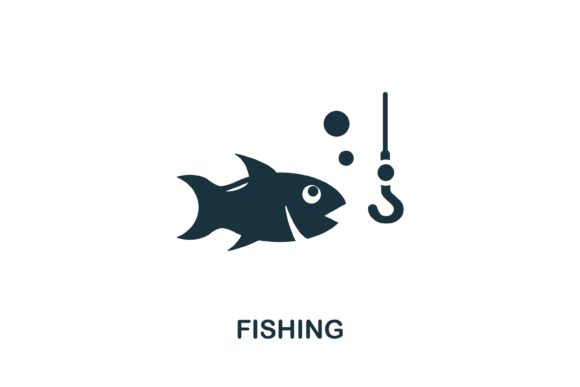
Evaluating the Fishing Icon for Professional Design Projects
In the vast ecosystem of digital assets, finding a graphic that balances aesthetic appeal with functional clarity is a persistent challenge for designers and content creators. The Fishing Icon from the vacation collection represents a specific category of vector graphics designed to bridge the gap between decorative illustration and utilitarian symbol. Unlike complex photographic imagery or overly intricate illustrations, this asset focuses on immediate recognition and scalability. For professionals managing web design projects, infographics, or branding materials related to outdoor recreation, understanding the practical value of this specific icon set is essential before integration into a workflow.
This resource is not merely a picture of fishing gear; it is a structured design element intended for commercial and editorial application. Its primary value proposition lies in its versatility across different media formats and its technical construction, which allows for significant modification without degradation. When evaluating digital assets, professionals must look beyond the thumbnail preview to assess how the file performs under real-world constraints, including responsive web environments, print production, and brand consistency requirements.
Technical Specifications and File Utility
The inclusion of both EPS and JPG formats addresses two distinct phases of the creative process. Understanding the interplay between these file types is crucial for maximizing the asset's lifespan within a project.
- EPS (Encapsulated PostScript): This is the master source file. As a vector-based format, it relies on mathematical paths rather than pixels. This means the Fishing Icon can be scaled from a 16px favicon to a billboard-sized advertisement without any loss of resolution or introduction of artifacts. For designers using Adobe Illustrator, CorelDRAW, or Affinity Designer, the EPS file provides access to individual anchor points, stroke weights, and color layers. This editability is non-negotiable for professional work where matching specific brand hex codes or adjusting line thickness for legibility at small sizes is required.
- JPG (Joint Photographic Experts Group): While often associated with photography, the JPG version here serves as a rapid prototyping and presentation tool. It allows stakeholders, clients, or team members who lack vector software to view, comment on, and approve the design concept quickly. However, for final production, the JPG should generally be avoided in favor of the vector source or exported SVG/PNG derivatives to maintain crisp edges against varying backgrounds.
The duality of this delivery method ensures that the asset remains accessible throughout the entire project lifecycle, from initial mood boarding to final prepress or web deployment. This reduces friction in collaborative environments where technical proficiency varies among team members.
Design Characteristics and Visual Communication
Effective iconography relies on reduction. The Fishing Icon succeeds by stripping away unnecessary detail to focus on the semantic core of the activity. In the context of a vacation collection, the design likely employs clean lines, balanced negative space, and a simplified silhouette. These characteristics are not just stylistic choices; they are functional necessities for user interface design and information architecture.
When used in web navigation or app interfaces, icons must be recognizable within milliseconds. Complex shading or realistic textures often fail at small display sizes, turning into visual noise. A simple illustration ensures that the symbol remains distinct on high-density mobile screens and low-resolution displays alike. Furthermore, the stylistic consistency implied by its inclusion in a broader "vacation collection" suggests that it shares visual DNA with related symbols like camping, hiking, or swimming. This cohesion is vital for creating unified infographic systems or directory listings where disparate icons must appear as part of a single family.
For marketers and publishers, this visual shorthand communicates leisure, patience, and nature without requiring textual explanation. It acts as a cognitive anchor, allowing users to scan content rapidly. In an era of diminishing attention spans, the ability of a well-crafted Fishing Icon to convey meaning instantaneously is a measurable usability advantage.
Practical Applications Across Industries
The utility of this graphic extends far beyond generic decoration. Different professional sectors leverage such assets to solve specific communication problems:
- Tourism and Hospitality: Resorts, lodges, and tour operators use these icons to denote amenities on websites and brochures. A clear fishing symbol on a property map or amenity list helps potential guests filter options efficiently, directly impacting booking conversion rates.
- Educational Content: Textbook publishers and e-learning platforms utilize simplified icons to break up dense text and illustrate concepts in biology, ecology, or recreational safety courses. The neutral, professional tone of a vector icon avoids the distraction of stylized cartoon art while remaining more engaging than plain text.
- Retail and E-Commerce: Sporting goods stores employ category icons to streamline navigation. Consistent iconography improves the user experience (UX) by reducing cognitive load, helping customers locate products faster.
- Editorial and Blogging: Content creators covering outdoor lifestyles use these graphics as featured image elements, section dividers, or pull-quote accents. They provide visual rhythm to long-form articles without the licensing complications or loading times associated with stock photography.
Assessing Editability and Customization Potential
The phrase "easy to edit" carries significant weight for freelancers and agencies working under tight deadlines. However, ease of editing is subjective and depends on the underlying construction of the vector file. A high-quality Fishing Icon should feature organized layers, logical grouping of elements, and minimal stray anchor points.
When you open the EPS file, you should expect to find a structure that respects your time. If the rod, reel, and line are grouped logically, recoloring the icon to match a client’s seasonal campaign takes seconds rather than minutes. Conversely, poorly constructed vectors with merged shapes or excessive gradients can turn a simple customization task into a reconstruction project. Professionals should always test the layer structure of a new asset before committing to it for a large-scale system. The true value of this Fishing Icon lies in its capacity to serve as a foundation for derivative works, allowing designers to adapt the base symbol for unique contexts without starting from scratch.
Integration Considerations and Limitations
While versatile, no single asset is universally perfect. Objective evaluation requires acknowledging potential limitations. As a "simple illustration," this Fishing Icon may lack the emotional resonance of a photograph for certain hero-section applications. It is a functional signifier, not necessarily a storytelling device. Users seeking gritty realism or high-art aesthetics may find the clean vector style too sterile for their specific brand voice.
Additionally, reliance on a single icon from a collection necessitates verification of style matching. If you already possess other vacation-themed icons, you must ensure the stroke width, corner radius, and perspective of this Fishing Icon align with your existing library. Mixing flat design icons with outlined styles, or combining isometric views with frontal perspectives, creates visual dissonance that undermines professional credibility. Always audit new assets against current design systems before implementation.
From a legal and ethical standpoint, users must also verify the specific licensing terms associated with the download. While the files are easy to edit, the rights to use them in commercial templates, resale products, or trademarked logos vary by provider. Ensuring compliance protects both the creator and the end-client from future intellectual property disputes.
Long-Term Value and Workflow Efficiency
Investing time in sourcing high-quality vector assets like this Fishing Icon pays dividends over the course of a career. Building a personal or agency library of reliable, editable symbols reduces repetitive labor. Instead of drawing a generic fishing hook for every new outdoor project, having a vetted, professionally constructed base file accelerates production timelines.
Furthermore, vector graphics are inherently future-proof. As display technologies evolve toward higher pixel densities and new aspect ratios, raster images require constant regeneration and optimization. A well-crafted EPS file remains relevant regardless of technological shifts. For entrepreneurs and small business owners managing their own marketing, this longevity translates to cost savings; an asset purchased once can serve across business cards, social media headers, email newsletters, and signage for years without needing replacement.
Ultimately, the decision to utilize this Fishing Icon should be driven by project requirements rather than impulse. It excels in scenarios demanding clarity, scalability, and consistency. It supports efficient workflows through standardized file formats and editable geometry. For professionals aged 20 to 50 navigating the demands of modern digital communication, it represents a pragmatic tool in the broader toolkit of visual expression. By prioritizing function alongside form, this asset demonstrates that effective design is less about artistic flourish and more about solving communication problems with precision and reliability.