The Strategic Value of the Tractor Icon in Modern Digital Design and AgTech Branding
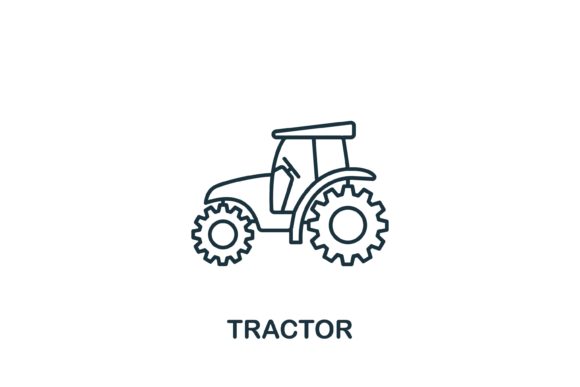
In the rapidly evolving landscape of digital communication, visual shorthand has become the primary language of user interface design and brand identity. Among the vast library of symbols available to modern creators, the Tractor Icon occupies a unique and increasingly vital position. Far from being a mere clip-art afterthought, this simple line element tractor symbol serves as a critical bridge between traditional industries and contemporary digital experiences. For professionals, marketers, and entrepreneurs operating at the intersection of agriculture, technology, and lifestyle, understanding the nuance of this vector graphic is essential for effective communication.
The demand for high-quality, editable assets like the Tractor icon reflects a broader shift in how we visualize primary industries. As agriculture becomes more technologically integrated, the visual representation of farming must evolve alongside it. The asset described here—a clean, minimalist vector available in EPS and JPG formats—is not just a picture of a vehicle; it is a functional design tool that addresses specific market needs for clarity, scalability, and semantic relevance in web design and infographics.
Redefining Agricultural Imagery in the Digital Age
Historically, agricultural imagery was often rustic, detailed, and photographically dense. However, the current trends in user experience (UX) and user interface (UI) design favor minimalism and cognitive ease. This is where the Tractor Icon proves its worth. In an era where users scan content rather than reading it linearly, a complex illustration can create friction. A simple line element tractor symbol, conversely, communicates the concept of "farming," "cultivation," or "rural industry" instantly without demanding significant cognitive load.
This shift is driven by the digitization of the agricultural sector itself. AgTech companies, farm management software providers, and sustainable food startups require branding that feels native to the web and mobile applications. They cannot rely on outdated pastoral aesthetics if they wish to signal innovation. The modern Tractor icon functions as a semiotic anchor, grounding high-tech platforms in their physical reality while maintaining the sleek aesthetic expected of SaaS products and fintech solutions. When a user navigates a dashboard for crop monitoring or equipment financing, this icon provides immediate contextual orientation.
The Technical Necessity of Vector Versatility
For freelancers and agency designers, the technical specifications of an icon are as important as its aesthetic form. The availability of this asset in both EPS file and JPG file formats addresses the dual nature of modern creative workflows. While raster images like JPGs offer immediate compatibility for quick mockups and social media posts, the EPS format is the industry standard for professional deliverables.
The EPS (Encapsulated PostScript) format ensures that the Tractor Icon remains infinitely scalable without loss of fidelity. This is non-negotiable for responsive web design, where assets must render crisply on everything from smartwatches to 4K monitors. Furthermore, because this symbol is designed as a simple line element, it is inherently easy to edit. Designers can adjust stroke weights to match existing brand guidelines, modify colors to adhere to accessibility standards, or combine the tractor with other geometric shapes to create composite logos. This level of malleability transforms a static symbol into a dynamic component of a larger design system.
Market Trends Driving Visual Demand
Why is there a surge in attention toward such a specific asset? The answer lies in several converging macro-trends that have elevated the status of agricultural symbolism in general commerce and culture.
- The Farm-to-Table Movement: Consumer packaged goods (CPG) brands are increasingly transparent about sourcing. Food labels, restaurant menus, and grocery e-commerce sites utilize the Tractor icon to signal authenticity and direct relationships with producers. In this context, the icon acts as a trust badge, verifying origin stories in a crowded marketplace.
- Sustainable Investing and ESG: Financial institutions and investment platforms focusing on Environmental, Social, and Governance criteria need visuals to represent regenerative agriculture and land management. A stylized tractor symbolizes productive stewardship, distinguishing these assets from generic industrial manufacturing icons.
- Rural Lifestyle and Real Estate: The post-pandemic migration toward rural areas has created a booming market for homesteading content, rural real estate platforms, and agritourism. These sectors require iconography that romanticizes the rural aesthetic without sacrificing modern usability. The clean lines of this vector graphic strike that balance perfectly.
- Educational Infographics: Non-profits and government agencies frequently publish data regarding food security, climate change, and rural development. Complex datasets require clear visual anchors. The Tractor Icon serves as a universal signifier in these infographics, helping diverse audiences parse statistical information quickly.
Workflow Efficiency for Modern Creators
Beyond market trends, the relevance of this asset is tied to changing professional expectations. The pace of content creation has accelerated. Marketers and designers no longer have the luxury of drawing bespoke illustrations for every minor UI element or presentation slide. The expectation is rapid iteration and deployment.
Assets that are "easy to edit and use" are not merely convenient; they are economic necessities. When a freelancer downloads a Tractor Icon package containing both vector and raster files, they are purchasing time. The pre-established geometry of a well-designed simple line element means the designer does not need to worry about pixel alignment or optical corrections. They can drop the EPS file into Adobe Illustrator or Figma, recolor it to match the client’s hex codes, and export it for production within minutes. This efficiency allows creative professionals to focus their mental energy on higher-level strategy and storytelling rather than basic shape construction.
Contextual Application and Best Practices
To maximize the SEO and user engagement value of this symbol, professionals must apply it with intention. Search engines and human users alike prioritize helpful, relevant content. Using a Tractor icon arbitrarily can dilute its impact. Instead, it should be deployed where it adds genuine semantic value.
- Navigation and Wayfinding: Use the icon in menu structures for categories related to machinery, field operations, or rural services. Ensure the accompanying text label is descriptive to support screen readers and SEO crawlers.
- Data Visualization: In annual reports or white papers, pair the icon with specific metrics (e.g., yield per acre, equipment ROI). The visual association helps memory retention and makes dry data more approachable.
- Brand Identity Systems: For AgTech startups, consider integrating the simple line element into the logomark or favicon. The simplicity of the vector ensures it remains recognizable even at 16x16 pixels in a browser tab.
- Presentation Decks: Investors and stakeholders respond better to visual cues than bullet points. Use the Tractor Icon as a recurring motif throughout pitch decks to maintain thematic consistency and reinforce the core business proposition.
The Intersection of Tradition and Innovation
Ultimately, the enduring relevance of the Tractor Icon speaks to a deeper cultural narrative. We are living in a moment where society is attempting to reconcile technological advancement with ecological necessity. The tractor itself is a machine of transformation—it turns soil into sustenance. In the digital realm, the icon performs a similar function: it transforms abstract concepts of industry and sustainability into tangible, understandable visual signals.
For the entrepreneur building a marketplace for organic produce, the marketer crafting a campaign for electric farm vehicles, or the educator explaining supply chain logistics, this asset is more than a graphic. It is a piece of communication infrastructure. By choosing a high-quality, editable vector asset that respects both design principles and industry context, professionals ensure their message is received with clarity and authority.
The provision of both EPS and JPG formats further underscores the utility of this resource. It acknowledges that while the final output may be digital, the workflow often involves multiple stages and software environments. Whether preparing a print brochure for a trade show or coding a responsive website, having access to the source vector file guarantees longevity and adaptability. As design trends continue to cycle and technology advances, the fundamental need to represent cultivation and machinery will persist. Having a robust, professionally crafted Tractor icon in one's asset library is a forward-looking decision that supports both immediate project needs and long-term brand consistency.
In conclusion, the simple line element tractor symbol is a testament to the power of reductive design in a complex world. It strips away the noise to reveal the essential function, allowing businesses and creators to communicate effectively across diverse platforms. As we move further into an era defined by the integration of biological and digital systems, such symbols will only grow in importance, serving as the visual vocabulary for a new generation of industry and innovation.